Fairness is a shared human compass, but men and women often calibrate it differently. Not because one group cares more than the other, but because lived experience, socialisation, and context shape how fairness is felt, measured, and defended.
Research in psychology finds that women tend to emphasise care and relational concerns in moral reasoning, while men more often emphasise rules, justice, and independence Oxford Research Encyclopedia of Social Work. This doesn’t mean one gender values fairness more, it means they may define and apply it differently.
Women score higher on deontological tendencies (avoiding harm even if it means less efficiency), while men lean slightly more toward utilitarian reasoning (maximising outcomes even if harm occurs) SAGE Journals. Both approaches are rooted in fairness, but through different moral lenses.
Fairness as rules versus fairness as relationships
- Structure and consistency: Many men tend to frame fairness as clear rules applied consistently: same standards, same consequences, same access. It’s about impartiality—no Favorites, no exceptions—and the confidence that outcomes flow from transparent criteria. This lens values predictability and merit, often measured by performance, results, or agreed metrics.
- Context and care: Many women lean toward fairness as relational equity: whose voices were heard, who carried invisible labour, and whether impacts were felt unevenly. It’s about inclusion, process dignity, and the recognition that identical treatment isn’t always equitable if starting points or burdens differ. This lens values participation, repair, and the health of relationships that systems rest on.
Both are fairness. One asks, “Were the rules applied?” The other asks, “Were people respected and outcomes just in practice?”
The invisible ledger: outcomes, effort, and impact
- Outcomes: A rule-first definition sees fair outcomes as the natural product of objective criteria. If the process is clean, the outcome is fair.
- Effort: A relational definition looks at contributions that systems often miss emotional labour, coordination, care work, and the glue that keeps teams together. If effort that matters goes unnoticed, fairness rings hollow.
- Impact: Fairness isn’t only what happened—it's how it landed. When decisions disproportionately burdensome, equity asks for adjustment so fairness doesn’t become a veneer over unequal realities.
Naming the ledger makes disputes more honest: fairness requires clean processes and accurate accounting for what truly creates value.
Why Perceptions Differ
Parenting responsibilities:
-
- Fathers may see 50/50 parenting time as fair because it reflects equal involvement.
- Mothers often highlight that fairness should consider who has historically carried the bulk of day-to-day care, emotional labour, and logistical responsibilities.
- For many women, “fair” means arrangements that prioritize children’s stability and continuity, even if that results in unequal time splits.
Property settlements:
-
- Men may view a 50/50 division of assets as straightforward fairness.
- Women often argue that fairness must account for non-financial contributions (raising children, homemaking, supporting a partner’s career).
- Courts in Australia apply the principle of “just and equitable” rather than “equal,” meaning settlements consider both financial and non-financial contributions, as well as future needs Justice Family Lawyers.
Practical Example
- A father may say: “Fair means I get 50% of the time with the kids and 50% of the property.”
- A mother may respond: “Fair means the children have stability, I’m supported in continuing to care for them, and my unpaid contributions are recognized in the property division—even if that’s not a neat 50/50 split.”
Understanding these differences helps in families, and negotiations
- In conflict resolution, men may respond better to fairness framed as clear rules and consistency.
- Women may respond better to fairness framed as empathy, inclusion, and relational balance.
- Mediators should blend both perspectives to create solutions that feel fair to everyone.
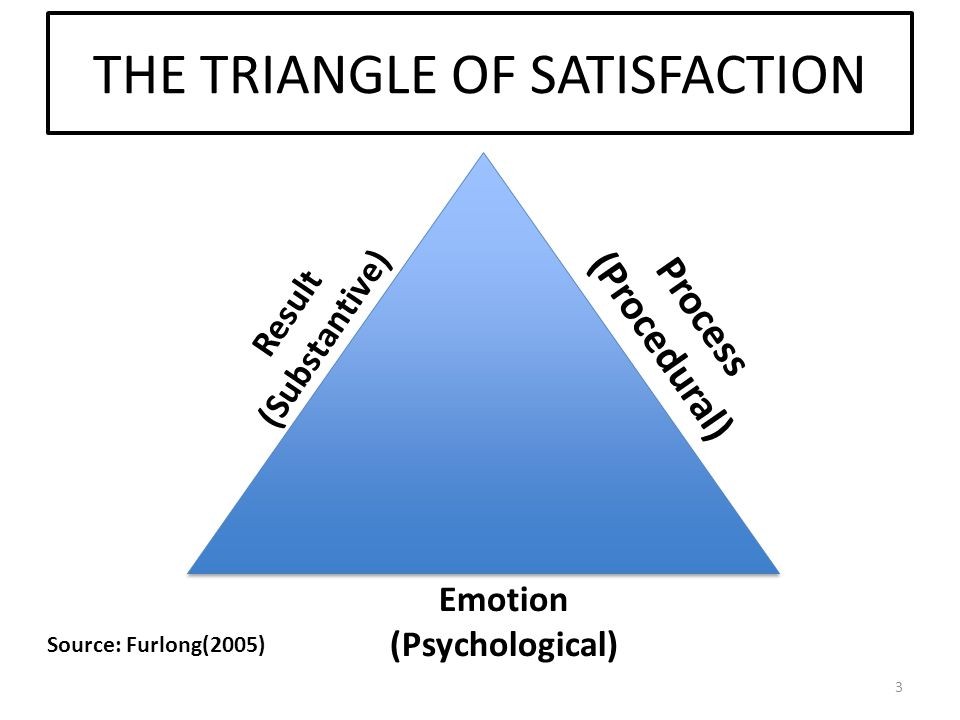
The Triangle of Satisfaction
The Conflict Triangle of Satisfaction integrates fairness through its “process” dimension, ensuring that decisions are made transparently, consistently, and equitably for all parties.
Here’s how fairness fits into the Triangle of Satisfaction, which includes three core elements: Substance, Process, and Emotional/Psychological.
The Three Sides of the Satisfaction Triangle:
1. Substance (What’s decided)
-
- Refers to the content of the agreement or resolution.
- Fairness here means the outcome is seen as equitable and just by all parties.
- Example: A fair division of assets in a family law dispute.
2. Process (How decisions are made)
-
- This is where fairness plays a critical role.
- A fair process includes:
- Transparency: Everyone understands how decisions are made.
- Participation: All parties have a voice and input.
- Consistency: Rules and standards apply equally to everyone.
- Legitimacy: Decisions are made by trusted and recognized authorities.
- If the process is perceived as unfair, even a fair outcome may be rejected
3. Emotional/Psychological (How people treat each other)
-
- Fairness here involves respect, trust, and acknowledgment.
- Parties feel heard and valued, which supports long-term cooperation.
- Example: Mediators ensuring respectful dialogue between disputants.
Why Fairness Is Central to Satisfaction
- Sustainable agreements: Fairness in all three dimensions increases the likelihood that parties will accept and uphold the resolution.
- Conflict prevention: When fairness is embedded in process and relationships, it reduces the chance of future disputes.
- Emotional buy-in: People are more likely to feel satisfied when they believe they’ve been treated fairly—even if the outcome isn’t perfect.
Final Thought
Fairness in family law is not always about equal shares—it’s about equitable outcomes.
How Men and Women Define Fairness Differently & The Triangle of Satisfaction
Your Emotional Divorce: Stepping-Stone to a Rewarding New Life
 MAGENTA 4 MEDIATORS